
Chase County Busted Mugshots
Every Chase County arrest record starts with the agency that made it. The Chase County Sheriff's Office sits at the center, since it runs the jail and holds the prisoners. A sheriff arrest can leave two trails. One is the sheriff's own report; the other, if the person stays in town, is a county-jail booking record. Imperial officers write their own reports, but the booking paperwork lands with the sheriff. Wauneta has no separate department, so the sheriff covers it under a village contract. Confirm the arresting agency and the booking location separately.
What does a booking capture? Name and identifying details, the arresting agency, the charges, bond figures if any were set, the facility, and any later release or transfer. A photo may be taken for identification. Chase County does not appear to publish an online photo list on its public pages. People search the word "busted" hoping to find one. It is a search term only, not a legal conclusion about anything.
Chase County busted mugshots come from booking records, and the details shown for each person vary with what the jail logged that day.
Chase Booking Record Fields
The county's public jail page won't hand you a full booking record with every field laid out. So be precise when you ask. Request the arresting agency and the booking facility. Ask for a case number if one exists. Also request a status label. That label tells you whether the person was just booked, released, transferred, or moved to state custody. A name and a date rarely add up to a sure match on their own. A focused request also helps the records custodian sort out what's public before spending time on it.
| Field to request or verify | Why it matters |
|---|---|
| Full name and identity details held by the custodian | Helps avoid matching the wrong person. A photograph alone is not a reliable identifier. |
| Booking or incident number, date, and time | Connects the record to a particular intake or event and distinguishes it from an older matter. |
| Arresting agency, location, and booking facility | Shows who created the report and where the jail record should be sought. |
| Alleged charge, count, bond, and court case number | Describes the charge as booked and provides a path for a later court cross-check. |
| Custody movement or release information | Separates just-booked, in-custody, released, transferred, and sentenced-state status. |
| Identification-photo status and restrictions | Asks whether a photo exists, whether it is public, and whether sealing, juvenile, or identity-error limits apply. |
Where an answer came from matters as much as the answer itself. Keep the agency name. Keep the exact source, the retrieval date, and the format. Note whether it's a live system, an archive, a court docket, a news report, or a directory. That trail matters here. The official Chase County web material never states how often a roster refreshes, what its photo policy is, or how long an entry stays visible. Without those details, a dated source trail is the only way to know what you actually have.
Chase Busted Photo Law
Under Nebraska Revised Statute §29-3521, photographs taken with an arrest for identification count as public criminal-history record material. The same statute lists police blotters, offense and incident reports, court records, and wanted or fugitive lists as public. What it does not do is force the county to run a searchable photo display or post every identification photo online. Nor can it keep an item public when some other rule applies. It simply gives you grounds to make a specific request to the right custodian.
That gap matters in Chase County. The official jail page offers a roster area plus CIDNET contact details. But there's no searchable photo roster and no stated photo-release policy. Whether a record is public and whether a portal shows it are two different questions. So ask directly whether a particular arrest-identification image exists and can be released. Don't assume a statute guarantees a web image.
No Nebraska anti-pay-to-remove statute appears in the official material. Start any correction with the responsible agency or court. A publisher's documented free review route, if one exists, comes second. A court order, a verified restriction, or an agency correction is what settles the record-status question.
- Booking
- Jail intake after an arrest or other custody event. It is not a finding of guilt.
- Bond
- A court-set condition connected to release. It is not a conviction or final case result.
- Disposition
- The later court outcome, such as dismissal, acquittal, diversion, conviction, or another resolution.
- Sealing
- A legal restriction that can make qualifying records nonpublic even when an agency retains a file.
Chase Requests Without Fee Guessing
Want a booking photo from the Chase County jail? There's no published fee schedule, no request form, and no turnaround promise to lean on. Don't borrow a fee from another Nebraska office either. What works instead is the standard public-records route: a written request built on Nebraska §84-712.01 and the Attorney General's public-records guidance. Under that framework, the custodian has four business days to grant access, hand over copies, issue a written denial citing legal grounds, or explain the delay and give the earliest practical release date.
Costs work out better for residents. The first eight cumulative staff hours are generally free statewide, though copying charges and a deposit or estimate may still apply. The office also gets to say no to creating a new database or reformatting a record it doesn't keep that way. So ask for an estimate before any work that might blow past the free hours. Keep your written request and the response filed together.
- Identify the event as narrowly as possible: person name if known, approximate date, agency, location, and the booking facility or likely facility.
- Name the records sought, such as a booking sheet, jail-register entry, arrest report, incident report, alleged-charge list, bond information, release or transfer record, and arrest-identification photograph if public.
- Send the request in writing through the sheriff's official contact route after asking which employee is the records custodian. Ask the office to identify material held by another agency or restricted from release.
- Request a written explanation for any partial denial, nonpublic status, or estimated cost. Use the responsible city department or court when it, rather than the sheriff, created the record.
Chase County Sheriff's Office
921 Broadway, Box 102
Imperial, NE 69033
308-882-4748
Non-emergency and records-custodian routing
Find Chase County Busted Records
Where you start depends on what you need to know. Worried someone is in custody right now? Call the sheriff's non-emergency line or use the county contact form. Ask plainly whether a current record exists and which channel can release it. That's the most direct local path, since no same-day online booking feed for the county checks out. Save 911 for real emergencies. A records question doesn't qualify.
| Channel | Custody or record slice | Photo finding and access |
|---|---|---|
| Sheriff and Chase County Jail | County jail custody and sheriff-created records | Official first route. A public roster area is visible, but online photo availability is not stated; contact the custodian. |
| Imperial Police Department | Imperial-created police reports | Official report-request route. No city arrest-photo feed was located. |
| Sheriff weekly blotter | Retrospective calls for service | No photos in the reviewed format. It is event context, not a named booking source. |
| Nebraska JUSTICE | Filed case and later disposition | No booking-photo field. New entries can lag, so it cannot prove same-day custody. |
| NDCS inmate search | State corrections custody | Last name or DCS ID plus CAPTCHA. No public photo field was observed. |
| BOP and ICE locators | Separate federal or immigration custody | Official location tools, not a Chase roster. The reviewed interfaces have no public photo field. |
Match the source to the record. A county booking starts with the sheriff. A report written in Imperial belongs to Imperial Police first. For an active case, Chase County Court holds the file. State and federal systems come into play only once their custody category is confirmed. A news story or directory can point toward a lead. Neither one replaces the agency that created the record or the current court file.
Chase Busted Roster Limits
The jail's official page covers CIDNET phone, data, video, email, and text services, along with the visitation rules. All of that is about staying in touch with someone in custody. None of it makes CIDNET a public-records request line or creates a right to copy a booking photograph. The page does show an "Inmate Roster" section. Its presentation, though, is too limited to serve much records purpose.
| What the reviewed jail page shows | What it does not state |
|---|---|
| A static roster area and jail communication instructions | Whether the list is live, complete, current, or updated on a regular schedule |
| Visitation and CIDNET information | A searchable booking database or a method to search by name |
| General jail-page content | Booking dates, charges, bond, booking IDs, release time, or an update timestamp |
| No stated online photo policy | Whether a photo exists for every booking, is public, or remains displayed after release |
A name on the jail's page is just a listing. It does not claim the person is still locked up right now. The sheriff's office can confirm present custody in a minute by phone. For an older, dated booking record, put the request in writing and send it to the records custodian.
Chase Blotter, Not Busted Bookings
The Sheriff's weekly blotter archive is official, but it looks backward. Each table lists a date, a time, a location, the nature of the call, and the responding department. Those departments can range from the sheriff and Imperial Police to EMS and fire crews. The context is useful, yet a blotter entry proves no arrest, no booking, and no ongoing custody. Treat it as a pointer. Then confirm booking status with the sheriff, the police department, the jail custodian, or the court file.
Nothing here amounts to a same-day or 48-hour Chase County booking feed. The blotter runs weekly, and a call logged in it may end with no arrest at all. Area news can help as a second lead. The North Platte Post's Wauneta report leaned on a sheriff release and named Lincoln County Jail as the booking spot. That is a good reminder: where an incident happened and where a person was booked can differ. The Imperial Republican runs individual area stories but keeps no standing booking section. Weigh the attribution, the publication date, and the named facility against official records.
Go to official sources first. The big national mugshot indexes carry no Chase County, Nebraska section, and a similarly named Kansas result belongs to the wrong state entirely. An unofficial directory may echo the sheriff's phone number. That repetition creates no live roster, no current photo, and nothing the county actually controls.
Chase Busted Alert Limits
The sheriff's home page offers RAVE Alerts and Smart911 signup for public-safety messaging. Enrollment there delivers emergency information, not booking notices, release notices, or mugshots. Think of it as a safety channel that happens to sit beside roster information. It is not an arrest alert.
NEVCAP is the state's official custody-movement notification and lookup system. Its facility material lists the Chase County Sheriff's Office in Imperial as an offline facility, and the site itself warns of notification-system problems. Check eligibility and coverage before relying on it. NEVCAP offers no comprehensive live Chase booking list and no public photo function. When a transfer or release could happen fast, confirm any notice straight with the holding agency.
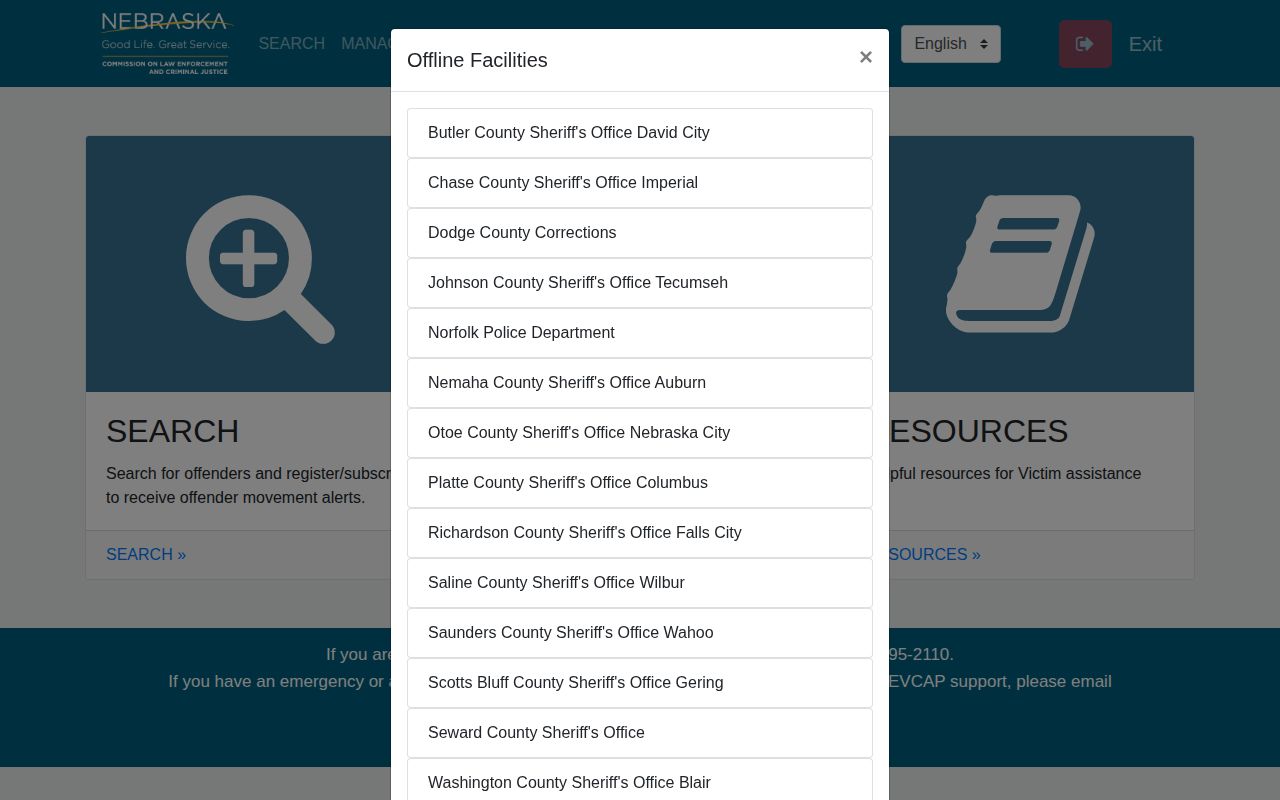
Enrollment in a notification system is no guarantee that every Chase booking surfaces there. Current custody still comes down to a direct confirmation from the agency holding the person.
Chase State, Court, Federal Custody
Nebraska Judicial Branch eServices and the JUSTICE name search cover courts, not jail rosters. A search can turn up a filed case, a summary, a register of actions, or a later disposition. New entries may lag by about 24 hours. So the system earns its keep after a booking, but it will not show a just-booked person the same day, and some custody events never produce a public case at all.
For that later-case check, the official JUSTICE case-name search is the court interface to use.
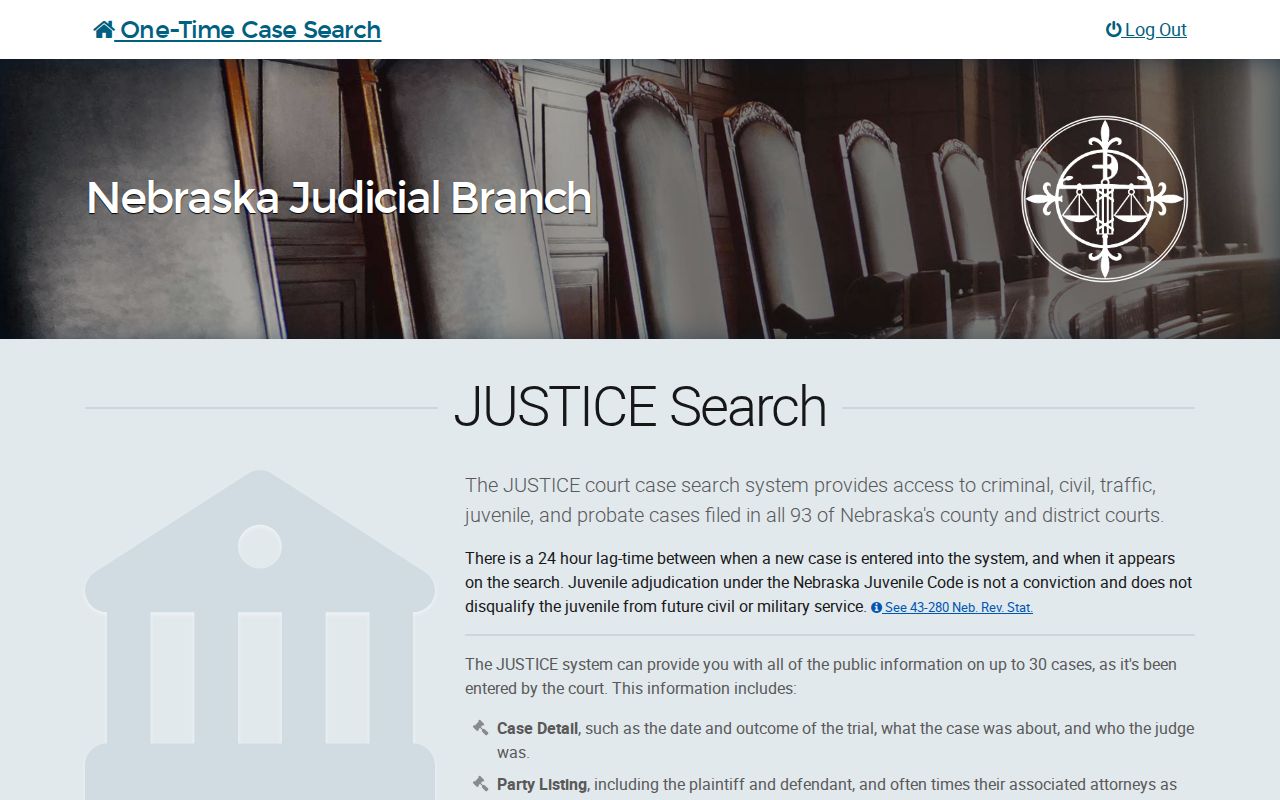
Its search screen serves court-record inquiries, not current bookings or photos. Read any dated result alongside the case status it shows.
The NDCS inmate search handles state corrections custody. It demands a last name or DCS ID plus a CAPTCHA. It skips the ordinary county booking population, and its public interface advertises no photo field. Call someone state custody only when the source itself backs that status. Written state-record requests go to the NDCS Public Disclosure Unit, not the county jail.
Federal and immigration custody sit on separate tracks again. The Federal Bureau of Prisons locator reports location and release details for qualifying current or former federal inmates. The ICE Online Detainee Locator follows its own exact-identity rules. Neither public tool offers photos. No known arrangement ties Chase County to federal or immigration detention, so treat any facility as unknown until an official source names it.
Chase Court Results After Booking
Booking data and court data tell different stories. One covers custody: who was held, when, and on what initial charge. The other follows the case itself, from arraignment through final disposition. Once a jail or agency record hands you a case number, party name, or date, take it to the Chase County Court and the JUSTICE system to confirm what actually happened. Court outcomes can reshape what an early booking entry seemed to say.
Nebraska law also limits what stays public. Under §29-3523, criminal-history information becomes nonpublic after certain outcomes. Dismissals count, along with acquittals, deferred judgments, diversions, and some no-charge situations. Each outcome carries its own timing and notice rules. A set-aside is not expungement, and neither is a blanket eraser. Even when an agency keeps a file under its retention schedule, a lawful restriction still controls what may be shared.
Found an error? Start with the agency or court that created the record, not a website repeating it. Bring the source URL or record identifier. Describe the problem precisely, and include only the documents that prove the fix. A publisher's free review process is worth using, but only after the official record itself is corrected or restricted. Search-engine takedown requests can clear a stale result once its source changes. They never change the record underneath.
Chase Juvenile Record Limits
Juvenile files deserve a hard stop before any public use. Nebraska's sheriff retention schedule admits that juvenile records can contain photographs. Keeping a file, though, is not permission to publish it. That schedule governs agency bookkeeping. It cannot override juvenile sealing, public-record exceptions, or a court order. An old source showing a name or photo does not mean it may be copied today.
The Nebraska Judicial Branch outlines which juvenile law-enforcement and court contacts seal automatically, plus other sealing routes. A sealed, expunged, juvenile, wrong-person, or otherwise nonpublic matter must never be reproduced. Ask the court or agency for a written explanation of the restriction. Keep any correction request limited to the record identifier and proof required. The same discipline applies to adult criminal-history information made nonpublic after a qualifying outcome.
Chase Custody Record States
One name can pass through several systems. They do not update in lockstep. A static roster, a court docket, and a state-custody search are distinct tools answering distinct questions. Each needs its own dated official source. An empty result in one system proves nothing about what another holds.
| Status to verify | Best starting source | What the source can and cannot show |
|---|---|---|
| Just booked or possible county custody | Chase County Sheriff's Office or jail custodian | Closest local route. The public page does not confirm a live, searchable booking list. |
| Listed on the jail page | Official roster area with retrieval date | Shows a posted name, but currentness, completeness, and persistence are not stated. |
| Released or transferred | Sheriff, jail, or dated court record | A release can remove a person from a roster without resolving the case or erasing the booking record. |
| Sentenced-state | NDCS search or NDCS records custodian | State corrections custody, not a fresh Chase County booking. |
| Sentenced-federal or immigration custody | BOP or ICE official channel | A separate system; no local facility should be inferred without confirmation. |
Keeping a record is not the same as publishing it. Nebraska's county-sheriff Schedule 15 lets adult inmate files, photographs included, be retained for 50 years in felony cases and 25 in misdemeanor cases. Jail registers and fingerprint cards follow separate schedules. None of those maximums mean Chase County keeps everything that long. None of them outrank sealing, juvenile limits, or a court order. For archive digging, send a narrow, dated request to the custodian or the Nebraska State Historical Society.
Chase City Busted Paths
Imperial and Wauneta run on separate agency tracks. For a report created by Imperial police, the Imperial Busted Mugshots route points to the Imperial Police Department's request channel at 740 Court Street, reachable at 308-882-4368. County jail custody and sheriff-created records still belong to the sheriff. Imperial's public police page offered no daily arrest bulletin, photo roster, or same-day booking feed.
Wauneta Busted Mugshots reflects the village's sheriff-contracted police setup, making the sheriff the primary local contact. No Wauneta booking log or photo feed could be verified. One regional report placed a Wauneta event in Lincoln County custody, so confirm the holding facility for each incident. Lamar lost its city page when its incorporation ended. Champion and Enders are unincorporated communities without separate police routes.
For older material, the Nebraska State Historical Society and the Lied Imperial Public Library hold newspapers and archived records worth checking. Old sources still need a current status review. A century-old jail register or clipping may carry a later court outcome or restriction that changes what counts as public now.
Get Chase County Booking Records In Person
Chase County Sheriff's Office
4 p.m. Chase County Sheriff's Office 921 BroadwayImperial, NE 69033
308-882-4748